Odyssey-3 opens free preview for real-time AI world generation
Odyssey’s public research preview lets users generate and explore interactive environments from text prompts, while the company pushes world models toward games and robotics.
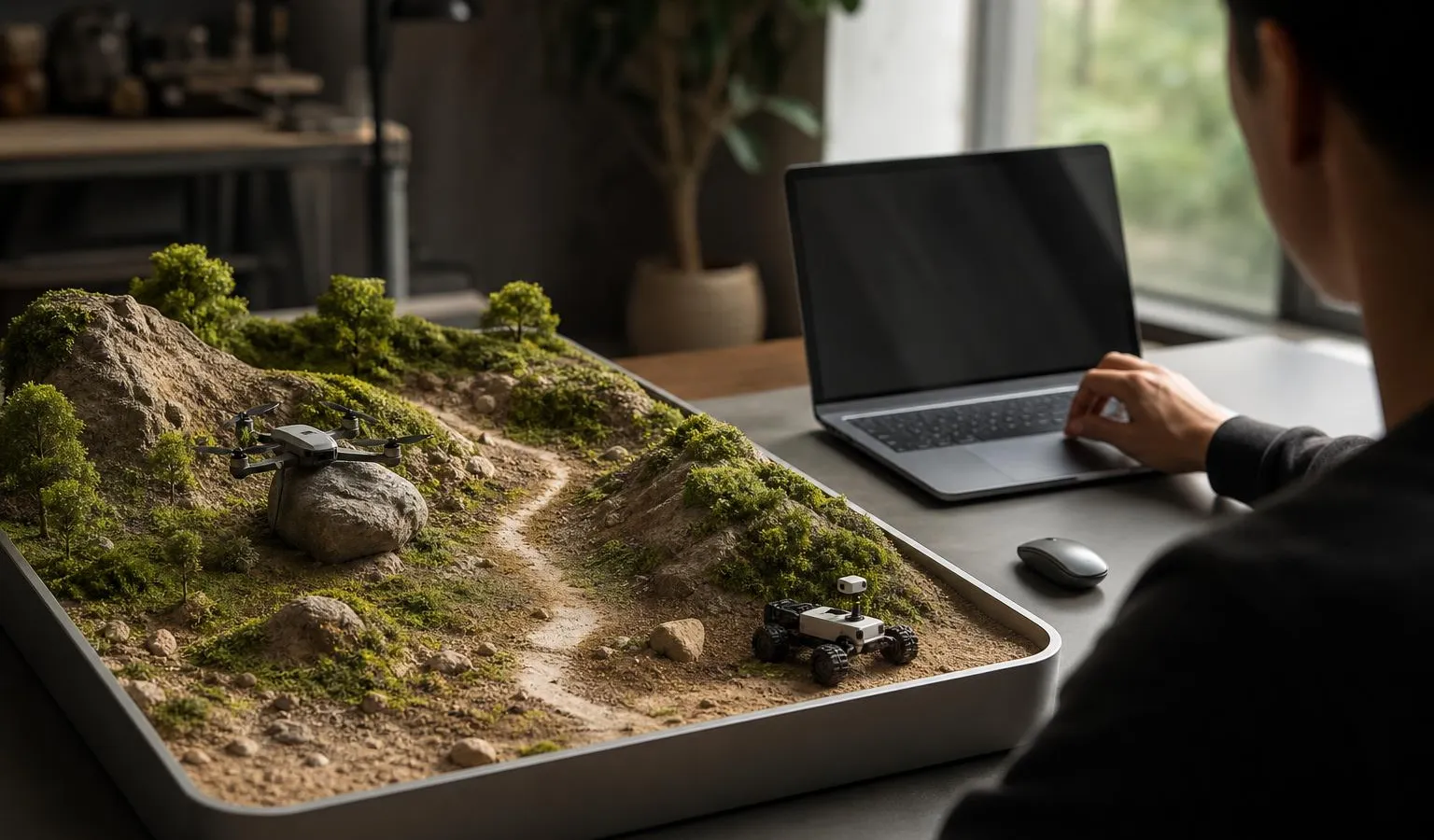
Odyssey has opened a public research preview of Odyssey-3, a generative world model that creates interactive environments from text prompts in real time. The free demo matters because it moves this kind of model from lab demo to something creators, prototypers and developers can actually test, even if the broader robotics and autonomous-system goals remain early.
The California-based company says Odyssey-3 can simulate physical processes and predict how a scene changes in response to user actions. Developers can also apply for API access, according to The Decoder.
What the free Odyssey-3 demo does
The public demo runs on Odyssey-3 Flash, a version of the model built for interactive generation. Users type a description, then move through the generated environment while the model continues producing new video frames.
According to Odyssey, the preview supports both first-person and third-person perspectives. Users can navigate the world, trigger events and watch the environment respond in real time.
That makes Odyssey-3 different from a standard text-to-video workflow. Many AI video tools focus on producing a finished clip from a prompt or image; Odyssey-3 is aimed at an environment that keeps updating as the user acts inside it. For creators who track the broader AI video market, it sits closer to interactive simulation than the tools in our AI video generator guide.
The company says the underlying model is an autoregressive diffusion transformer. In simpler terms, it generates each new frame based on what came before and what the user does next. Odyssey says it trained the model on visual observations so it could learn physical relationships and cause and effect.
How Odyssey says the model was trained
Odyssey says its training data combined several kinds of visual material: internet videos with event descriptions, video game footage matched with keyboard and mouse inputs, and simulated physical interactions. The company also describes an additional training method designed to reduce the compute steps needed for generation, which it says enables real-time output.
The base Odyssey-3 model has 14 billion parameters and generates video at 832 × 480 pixels, according to the company’s benchmark submission. Odyssey-3 Pro supports 1280 × 720 pixels.
For creators, the immediate takeaway is not just resolution. The more important question is whether a generated scene stays coherent when a user moves, changes viewpoint or interacts with objects. That is the difference between a short generated video and a usable interactive sketch for a game, virtual scene or training simulation.
Benchmark claims need careful reading
Odyssey is presenting Odyssey-3 as a strong physics model, but the benchmark details are important.
On Physics-IQ Verified, Odyssey-3 Pro scored 66.1 points, according to the company. The benchmark evaluates how well models continue videos of real-world experiments across fields such as fluid mechanics, optics, solid mechanics, magnetism and thermodynamics, then compares the generated continuation with the real outcome.
That headline result comes with a caveat. The Decoder reports that the 66.1 score came from a single run where a selection method chose one of eight generated videos for each task. The benchmark’s rules require four test runs with standard deviation reported for a record claim. Without that selection method, Odyssey-3 Pro averaged 63.37 points across four runs. Both results appear on the official leaderboard and were submitted by Odyssey.
The company also reports strong WorldMark results. According to Odyssey’s own evaluation, Odyssey-3 ranks first in three of four categories: First-Person Stylized at 77.2, Third-Person Real at 79.0 and Third-Person Stylized at 76.3. In First-Person Real, it places third with 80.6 points. WorldMark tests control following, image quality and consistency over time.
For users, those numbers are useful signals but not a substitute for testing. A model that scores well on controlled benchmarks may still behave unpredictably when prompted with unusual scenes, fast movement or creator-specific requirements.
Why game and robotics teams will watch it
Odyssey is positioning the same world model as a foundation for multiple control tasks. The company says it can be paired with specialized controllers for applications including robotic arms, drones and video game characters.
In robotics tests, Odyssey says an AI system built on Odyssey-3 controlled multiple robotic arms after training on a few dozen hours of demonstration data. The company also says the robots recovered from failed grasps, even though those cases were not included in the training data.
For humanoid robots, Odyssey is working with Swiss robotics company Flexion. According to Odyssey, controllers built by Flexion on Odyssey-3 performed more reliably than comparison models when conditions changed.
The company also trained a drone controller on simulated flight data. In a virtual indoor setting, the drone could avoid obstacles and fly toward specified targets on command, according to Odyssey.
The gaming demos may be the most immediately understandable for creators. Odyssey showed an AI autonomously playing GTA V, including driving and fighting enemies. It also says a controller trained on roughly two hours of GTA footage transferred to Red Dead Redemption 2 without extra training, where it moved a character on horseback.
For small studios and solo game makers, the public preview is worth watching as a prototyping signal rather than a production pipeline. The current public release offers interactive environment generation; Odyssey says robotics and autonomous systems still need more work. If the approach matures, it could become a way to rough out playable spaces, test control ideas or train agents inside generated simulations before committing to full development.
Frequently asked questions
What is Odyssey-3?
Odyssey-3 is a generative world model from Odyssey that creates interactive environments from text prompts and lets users explore them in real time.
Is Odyssey-3 available to the public?
Yes. Odyssey has launched a public research preview with a free online demo running on Odyssey-3 Flash, and developers can apply for API access.
What are Odyssey-3’s intended uses beyond virtual worlds?
Odyssey says the model is designed as a foundation for controllers in areas such as robotic arms, drones, humanoid robots, video game characters and AI agents.