ElevenLabs vs Murf AI: 2026 Buying Guide
ElevenLabs is stronger for realism, cloning, dubbing and APIs. Murf AI is better for polished studio voiceovers and nontechnical production teams.
We may earn a commission when you buy through links on this page. It never affects our verdicts. How we make money.
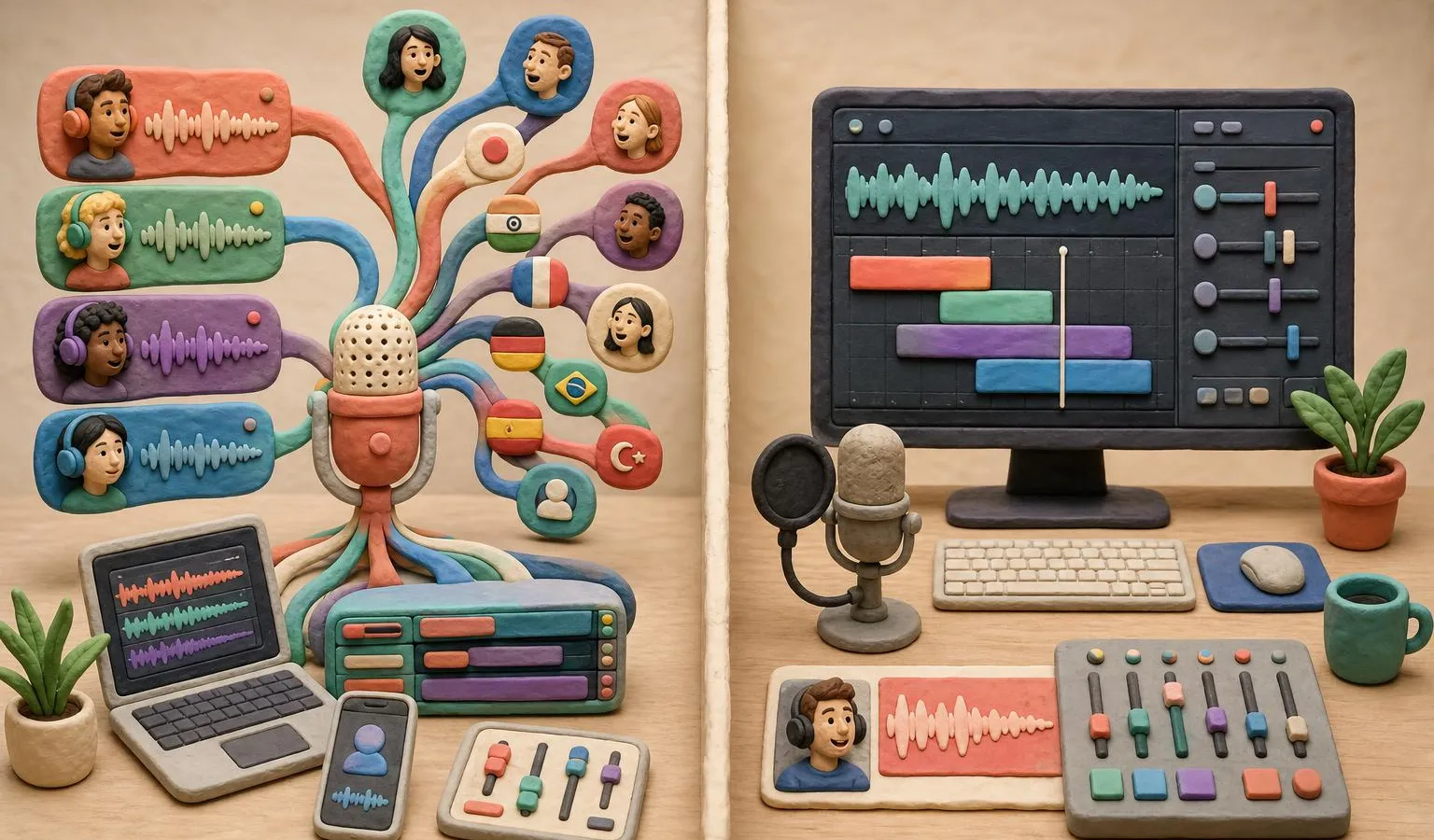
ElevenLabs and Murf AI both turn text into synthetic speech, but they are built around different buyer needs. ElevenLabs has become a broad AI audio platform: text-to-speech, voice cloning, dubbing, speech-to-text, voice agents, sound effects, music, image/video workflows and APIs. Murf is more focused on the production side: a browser studio for polished voiceovers, translation, dubbing, voice controls, exports and API options for teams that need reliable narration workflows.
This comparison is based on the vendors' documentation, pricing pages and published product updates available in the research set. The practical difference is simple: ElevenLabs looks like the stronger pick when realism, emotional range, multilingual coverage and developer flexibility matter most. Murf AI looks more comfortable for teams making training videos, ads, presentations and localized voiceovers in a studio-style workflow.
Quick verdict: choose ElevenLabs if you want the most capable all-around AI voice platform, especially for realistic voices, cloning, dubbing across many languages, conversational agents or API-led products. Choose Murf AI if your main job is producing clean voiceovers in a browser studio, with timing, pronunciation, pitch and pacing controls that are approachable for marketing, learning and content teams.
| Feature |  ElevenLabs |  Murf AI |
|---|---|---|
| Best for | Creators and developers needing top-tier AI voices and voice agents | Teams producing polished voiceovers, training, ads, and localization |
| Category | Voice | Voice |
| Pricing | Freemium | Freemium |
| Starting price | Free plan · from $6/mo | Free plan · from $29/mo |
| Our score | 9.3 | 8.2 |
| Strengths |
|
|
| Visit | Visit site | Visit site |
Pricing and free plans
At the time of writing, ElevenLabs has a free plan and paid tiers starting with Starter at $6 per month on monthly billing after a $1 first month; its listed paid ladder also includes Creator at $22, Pro at $99, Scale at $299, Business at $990 and custom Enterprise pricing. Murf AI has a free workspace, Creator at $29 per month monthly according to a recent third-party pricing check, Creator at $19 per month when billed annually on Murf's official pricing page, Business at $99 per month monthly or $66 per month annually, and custom Enterprise pricing. Murf's official pricing crawl confirmed annual Creator pricing but not the monthly-toggle price, so treat the $29 monthly figure as less certain than the annual figure.
ElevenLabs has the more generous free plan if you want to actually explore a range of features. Its free plan includes 10k credits per month, text-to-speech, speech-to-text, sound effects, voice design, music, productions, image and 3 Studio projects. The catch is important: the research notes that the free plan lacks paid-plan commercial usage rights. So it is useful for testing, prototyping and learning the platform, but creators and businesses should expect to move to a paid plan before publishing commercial work.
Murf's free workspace is more restrictive. It includes 10 minutes of voice generation, 2 project credits and 1 editor, but no downloads and no commercial rights. That makes it more of a product trial than a usable free production tier. You can evaluate the editor and voice direction, but you cannot treat the free plan as a working plan for client deliverables, training modules or social ads.
For paid entry, ElevenLabs is cheaper to start. It also gives a commercial license on its low-cost paid entry plan, according to the research. Murf's Creator plan costs more, but its value depends on whether you prefer a structured studio environment and its voiceover controls over a broader credit-based platform.
The main pricing caution with ElevenLabs is predictability. The research describes its pricing as credit-based and potentially hard to forecast across products. That matters because ElevenLabs is not just TTS: you may use credits across dubbing, cloning, sound effects, music and other workflows. Murf's annual Creator and Business plan allowances are described as clearer, but several advanced capabilities sit higher up the plan ladder or are Enterprise/add-on oriented.
Core features and output quality
ElevenLabs has the broader feature set. Its text-to-speech stack includes Eleven v4, v4 Turbo, v3, Multilingual v2 and Flash models. The Eleven v4 family supports 90+ languages, and ElevenLabs also offers automatic dubbing for audio and video across 90+ languages. On top of that, it includes instant and professional voice cloning, a Voice Library with 10,000+ community-shared voices, low-latency conversational voice agents, API access, speech-to-text, voice changer, sound effects, music, image/video and Studio workflows.
Its strongest argument is output quality. The research calls out excellent voice realism and emotional range. ElevenLabs also launched Eleven v4 and v4 Turbo on Sep 28, 2026, with a focus on more emotive TTS, faster responses and stronger cloning. If your audience will hear the voice front and center — audiobook-style narration, character work, branded voices, creator videos, multilingual ads or voice agents — ElevenLabs is the safer bet on raw voice quality.
Murf AI is not trying to match ElevenLabs feature-for-feature across every AI audio category. It focuses on studio voiceover production. Its web product pages describe 200+ Studio voices across 35+ languages. Its API documentation describes 150+ voices, 35 languages and 20+ speaking styles. Murf also offers Gen2 for studio-quality, customizable speech synthesis and Falcon 2.1 real-time TTS, with under-100ms time-to-first-audio in its API docs.
Murf's production controls are its biggest strength. The platform supports speed, pitch, pauses, pronunciation, duration, variation and Multi Native output. Those controls matter when you are matching a voiceover to slides, product footage, explainer scenes or training content. A slightly less expressive model can still win in a workflow if it lets an editor quickly fix pronunciation, tighten timing and keep delivery consistent across a project.
Both tools now reach beyond simple TTS. ElevenLabs has voice agents, dubbing, cloning and creative audio generation. Murf has voice changer, translation, dubbing, streaming and WebSocket API capabilities. Murf also added API voice cloning for Enterprise customers on Sep 8, 2026, from a reference recording up to 30 seconds. But if cloning is central to your use case, ElevenLabs is easier to recommend because cloning is a more prominent part of its product offering, while Murf's cloning is described as Enterprise/add-on oriented.
There is also a governance angle. Synthetic voices, music and likeness rights are becoming more sensitive areas; for broader context, see our coverage of Elvis and Eminem rights holders suing Suno over AI music clones. That does not make either ElevenLabs or Murf a bad choice, but it does mean buyers should pay attention to commercial rights, cloning permissions and internal approval processes.
Ease of use
Murf AI should feel easier for a nontechnical production team. Its core promise is a polished browser studio for voiceover creation. If your workflow is script, scene, voice, timing and export, Murf's editor-style approach is a natural fit. The voice controls are also framed in terms content teams understand: pauses, pronunciation, pitch, pacing, duration and variation.
That makes Murf especially attractive for learning and development teams, marketers, agencies and small businesses that do not want to think about models, credits across product lines or API setup. The free plan's lack of downloads limits real use, but it can still help a team decide whether the editor feels manageable before paying.
ElevenLabs is not necessarily hard to use, but it is wider and therefore more complex. A creator can start with text-to-speech quickly, yet the platform also includes dubbing, voice design, cloning, agents, sound effects, music, image/video, Studio projects and APIs. That breadth is useful when you know what you want. It can be more to evaluate when all you need is a clean voiceover for a course module.
For solo creators, ElevenLabs may still be the easier long-term choice because one account can cover many audio tasks. For a team with a defined production process, Murf may require less decision-making. In short: Murf is easier to explain to a video team; ElevenLabs is more powerful once you start building broader voice systems.
Integrations/workflow fit
ElevenLabs fits best into creative and technical workflows. Developers get API access and low-latency conversational voice agents. Creators get TTS, voice cloning, dubbing, sound effects, music and Studio workflows. Localization teams get automatic dubbing across 90+ languages. If you are building a voice feature into an app, producing multilingual media, or experimenting with synthetic characters and agents, ElevenLabs has more surface area to grow into.
It also fits the direction of the wider voice AI market, where voice is becoming part of agents, apps and real-time interfaces. For related industry context, see our coverage of Deepgram buying Daily to add Pipecat to its voice AI stack and Block unveiling Dessa, a speech-only AI model for emotional voice cues. Those stories point to the same trend: voice tools are moving beyond narration into interactive systems.
Murf fits production workflows better than engineering-first ones. Its studio integrations and exports include Canva and PowerPoint, and paid plans include unlimited downloads. That makes sense for presentation narration, marketing videos, training content and quick creative review cycles. A user can create a voiceover, adjust timing and pronunciation, then move the asset into the tools teams already use for visual production.
Murf also has API options, including streaming and WebSocket capabilities, so it is not only a studio product. Falcon 2.1's under-100ms time-to-first-audio target in the API docs is relevant for real-time experiences. Still, Murf's center of gravity is more production studio than broad AI audio lab. ElevenLabs is more likely to suit a team that wants one vendor for voice generation, agents, dubbing, cloning and experimental media.
Limitations
ElevenLabs' main limitation is cost predictability. Credit-based pricing can be hard to model when teams use multiple products. A creator who only generates short clips may find it simple enough, but a business using TTS, dubbing, sound effects, cloning and agents should monitor usage carefully.
Its plan structure also matters. Professional voice cloning and higher audio quality features require higher tiers, according to the research. Advanced collaboration and seat counts start on expensive business tiers. And the free plan, while broad, does not include paid-plan commercial usage rights. ElevenLabs can be inexpensive to start, but not every serious workflow remains inexpensive.
Murf's main limitation is that the free plan is too constrained for real production. No downloads and no commercial rights mean you will need a paid plan before shipping anything. The research also notes that published Studio plans below Enterprise appear limited to 1 editor, which may frustrate teams expecting multi-person review and production inside the app.
Murf also puts several advanced features higher up the stack. Collaboration, SSO and voice cloning are Enterprise/add-on oriented. Its language coverage on the web product pages, 35+ languages, is narrower than ElevenLabs' 90+ language coverage on the Eleven v4 family and dubbing. For heavy localization, that difference is not minor.
Finally, Murf's monthly Studio pricing is less transparent in the research set. The annual Creator price is confirmed from Murf's official pricing page, while the monthly Creator price comes from a recent third-party page that says it checked Murf's monthly toggle. That is not a deal-breaker, but buyers should verify current pricing directly before committing.
Who should choose ElevenLabs
Choose ElevenLabs if voice quality is the top priority and you need more than basic narration. It is the better fit for creators producing polished spoken content, businesses localizing audio or video into many languages, developers building voice agents, and teams that want cloning, dubbing and APIs under one roof.
It is also the stronger choice if you want room to experiment. The product suite covers TTS, STT, dubbing, voice changer, sound effects, music, image/video and Studio workflows. That breadth is useful for creators who do not want to stitch together separate tools for every audio task.
The trade-off is management. You need to understand credits, commercial rights and which features require higher tiers. If you are buying for a team, also check collaboration needs early, because advanced seats and collaboration start on expensive business tiers.
Who should choose Murf AI
Choose Murf AI if your main job is making professional voiceovers inside a structured editor. It is a good fit for training videos, sales enablement, ads, presentations, explainers and localization workflows where timing and pronunciation control matter as much as raw model expressiveness.
Murf is especially sensible for nontechnical teams. Canva and PowerPoint export/integration support, unlimited downloads on paid plans and editor-friendly controls make it easier to fit into existing content production. If your team thinks in slides, scenes and scripts rather than APIs and models, Murf will likely feel more direct.
The trade-off is ceiling and plan flexibility. The free plan is only for evaluation, plans below Enterprise appear limited to 1 editor, and cloning/collaboration/SSO are more Enterprise-oriented. If you need broad language coverage or a full AI audio platform, ElevenLabs has the advantage.
Our verdict
ElevenLabs wins the overall comparison for most buyers who care about the best AI voice output, broad multilingual coverage and future-proofing. Its realism, emotional range, 90+ language support on the Eleven v4 family, automatic dubbing across 90+ languages, large Voice Library, cloning options and voice-agent/API capabilities make it the more ambitious platform.
Murf AI is still the better practical choice for some teams. If your work is mostly structured voiceover production, Murf's browser studio, pronunciation and timing controls, Canva and PowerPoint workflow fit, and paid-plan downloads may matter more than having the widest AI audio feature set.
So the decision comes down to your center of gravity. Pick ElevenLabs for high-end voice realism, cloning, dubbing, multilingual production and developer-led voice experiences. Pick Murf AI for predictable studio voiceover work by marketing, training and content teams that want a simpler production environment.
Frequently asked questions
Does ElevenLabs have a free plan?
Yes. ElevenLabs has a free plan with 10k credits per month, TTS, STT, sound effects, voice design, music, productions, image and 3 Studio projects. The research notes that the free plan lacks paid-plan commercial usage rights.
Does Murf AI allow downloads on the free plan?
No. Murf's free workspace includes 10 minutes of voice generation, 2 project credits and 1 editor, but it has no downloads and no commercial rights.
Which tool supports more languages?
ElevenLabs has the broader stated language coverage, with 90+ language support on the Eleven v4 family and dubbing across 90+ languages. Murf lists 35+ languages on its web product pages and 35 languages in its API documentation.
Which is better for voice cloning?
ElevenLabs is the stronger general choice for cloning because it offers instant and professional voice cloning as a core part of the platform. Murf added API voice cloning for Enterprise customers from a reference recording up to 30 seconds.
Sources
- ElevenLabs Pricing for Creators & Businesses of All Sizes
- Text to Speech | ElevenLabs Documentation
- Dubbing Overview | ElevenLabs Documentation
- Voice Cloning overview | ElevenLabs Documentation
- Introducing Eleven v4, our most emotive model
- Changelog | ElevenLabs Documentation
- Murf.AI text to speech Pricing | Get started for free
- What is a Workspace? | Murf Help Center
- Free Text to Speech Online with 200+ Realistic AI Voices | Murf AI
- Murf API | Documentation
- API Features | Murf Help Center
- Murf AI Product Changelog & Updates
- Murf Pricing 2026: Plans, Fees, and Is It Worth It?