Anthropic's Claude Fable 5.2 paints images with code, no diffusion required
The new model writes Python programs to place hundreds of thousands of simulated brushstrokes, but the compute cost and speed tradeoffs remain open questions.
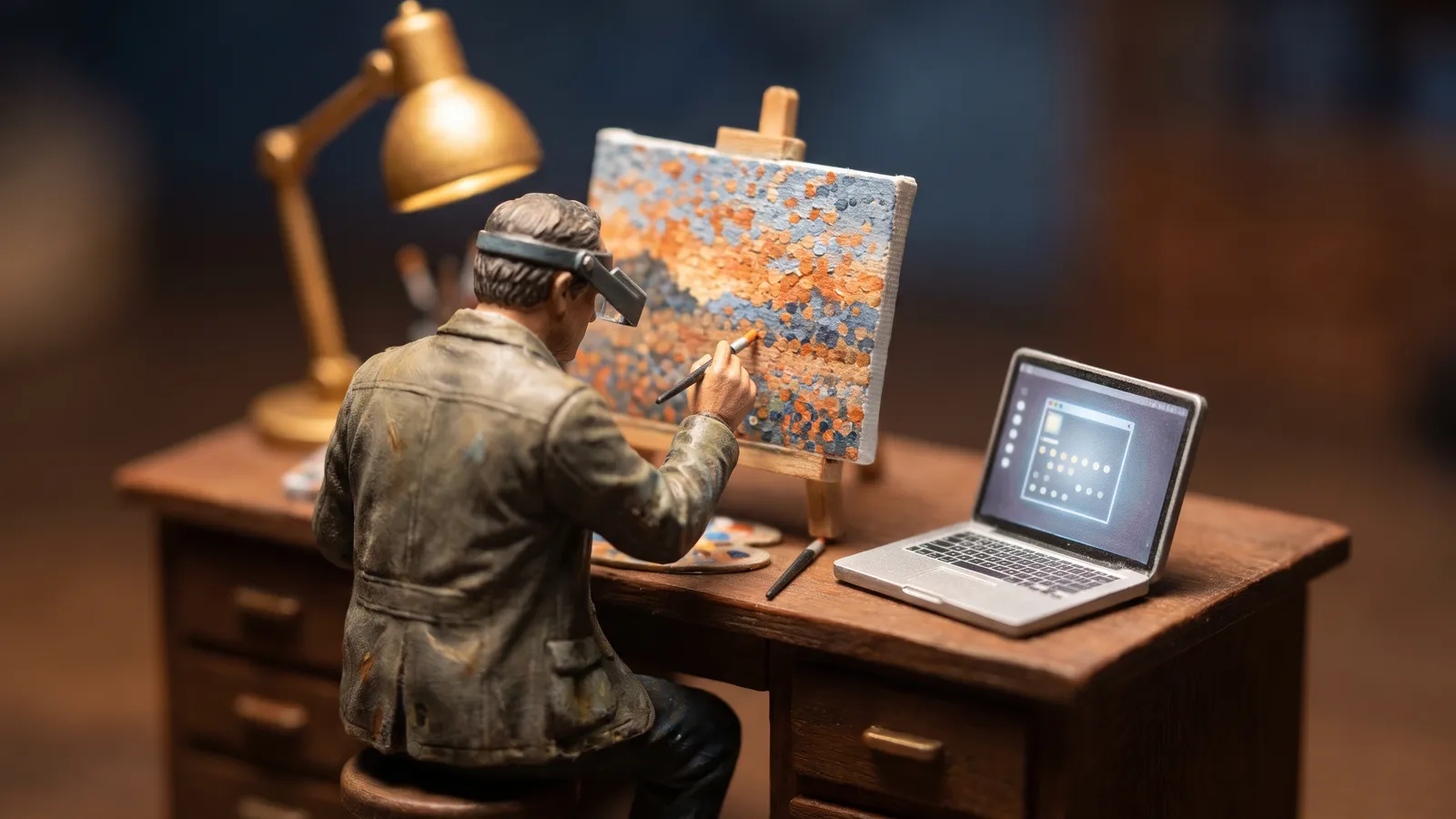
Anthropic's Claude Fable 5.2 takes a radically different approach to image creation: instead of using diffusion like most current AI image generators, it writes Python code that places hundreds of thousands of simulated brushstrokes on a virtual canvas. According to The Decoder, the model simulates physical painting properties including bristle texture, paint application, and even the need to paint over its own mistakes.
How code-based painting works
Fable 5.2 does not rely on an external image model or pre-rendered source images. According to Anthropic developer Jake Eaton, each piece is a Python program of 1,000 to 2,000 lines that drives a simulated paint engine. The approach resembles agentic image editing, where a language model picks tools and evaluates results.
In one demonstration, the model generated an image of a shopping cart in a parking garage using roughly 700,000 simulated brushstrokes. In another, it painted a bird at sunrise from exactly 111 coordinate sequences over 21 seconds. The model even added a deliberate seven-pixel wobble to its first stroke, reasoning that a human arm would not draw a perfectly straight line.
The system has no undo button. Once a stroke is placed, the model must commit to it. Between passes, Fable 5.2 inspects the canvas and reacts to its own errors. When the bird's back came out too thin and scraggly, the model laid a bolder stroke over it, and the stray bristle marks along the edges ended up looking like ruffled feathers.
How it compares to diffusion models
Most popular AI image tools like Midjourney use diffusion, which gradually refines a noisy image into a clear result. Fable 5.2 instead simulates the physical painting process step by step. This means the model can self-correct mid-painting, but it also means each image requires far more computation than a single diffusion pass.
The tradeoff is speed versus control. Diffusion models produce finished images in seconds. Fable 5.2 needs several thousand brushstrokes per painting, and Eaton reportedly redirects the model with comments between strokes. For creators who need quick visual concepts, diffusion remains the faster path. For workflows that require iterative, tool-by-tool construction, the agentic painting approach offers something diffusion cannot.
Earlier attempts with Anthropic's sibling model Opus 5.5 drew criticism for merely imitating existing art. Eaton responded by having Fable 5.2 develop its own artist personas with fictional backstories and consistent styles, an approach that could interest illustrators and brand designers looking for repeatable visual identities rather than one-off images.
What this means for creative workflows
For marketers and small businesses, the practical question is whether code-based painting justifies its compute cost. The model's ability to self-correct and maintain spatial reasoning could help with detailed product illustrations or scenes where consistency matters. In one 280-stroke piece showing two people painting at dusk, the model accidentally smeared paint tubes and a cup with a late lighting effect, then repainted those objects after the fact. It also positioned both figures so their inner shoulders could touch, matching the prompt's spatial requirements.
That level of spatial reasoning extends beyond virtual canvases. Anthropic says Fable 5.2 is built for demanding long-horizon technical tasks. In internal tests, the model solved two open problems in black hole physics, designed three working electronic devices with circuit board manufacturer Diode, and used more than 1,000 sub-agents to program its own laptop operating system in eight days. Anthropic also announced a sibling model, Mythos 5.2, designed for verified security and biology researchers.
What to watch
The benchmark numbers are notable. On Anthropic's internal RoboDojo Sim benchmark, Fable 5.2 scored 64.9 percent compared with 29.8 percent for OpenAI's GPT-6 Astra. But a real-world test by AI researcher Aris Zhu, in which both models used physical robot arms to paint Van Gogh's "The Starry Night," showed limits in fine motor control. Astra painted faster and, so far, is the only model that has managed to stand a domino on end by slowly loosening its gripper to use gravity as a pivot point.
For now, Fable 5.2's painting approach is a research demonstration rather than a product feature. Creators watching this space should look for whether Anthropic packages the simulation engine into a consumer-facing tool, and whether the compute cost of hundreds of thousands of brushstrokes can come down enough to compete with diffusion-based generators on price and speed.
Frequently asked questions
How does Claude Fable 5.2 generate images differently from diffusion models?
Fable 5.2 writes Python code that places individual brushstrokes on a virtual canvas, simulating physical properties like bristle texture and paint application. Diffusion models like Midjourney instead gradually refine a noisy image into a clear result.
Can Fable 5.2 undo brushstrokes once placed?
No. The system has no undo button. Once a stroke is placed, the model must commit to it and paint over any mistakes, similar to how a real painter works.
How did Fable 5.2 compare to OpenAI's GPT-6 Astra in robot arm tests?
Fable 5.2 scored 64.9 percent on Anthropic's internal RoboDojo Sim benchmark versus 29.8 percent for GPT-6 Astra. However, in a real-world test painting The Starry Night, Astra was faster and demonstrated better fine motor control in some tasks.